Why the 2026 Budget is Driving Australian Innovation Overseas
Katrina Ryl
The numbers behind starting a tech company have always been terrifying: 4 out of 5 startups fail. Founders accept those odds because the payoff for surviving the gauntlet—sacrificing years of market-rate salary, working 80-hour weeks, and risking personal financial ruin—is the chance to build generational wealth. With the 2026 Federal Budget, the government just fundamentally disrupted that risk-reward equation.
Date
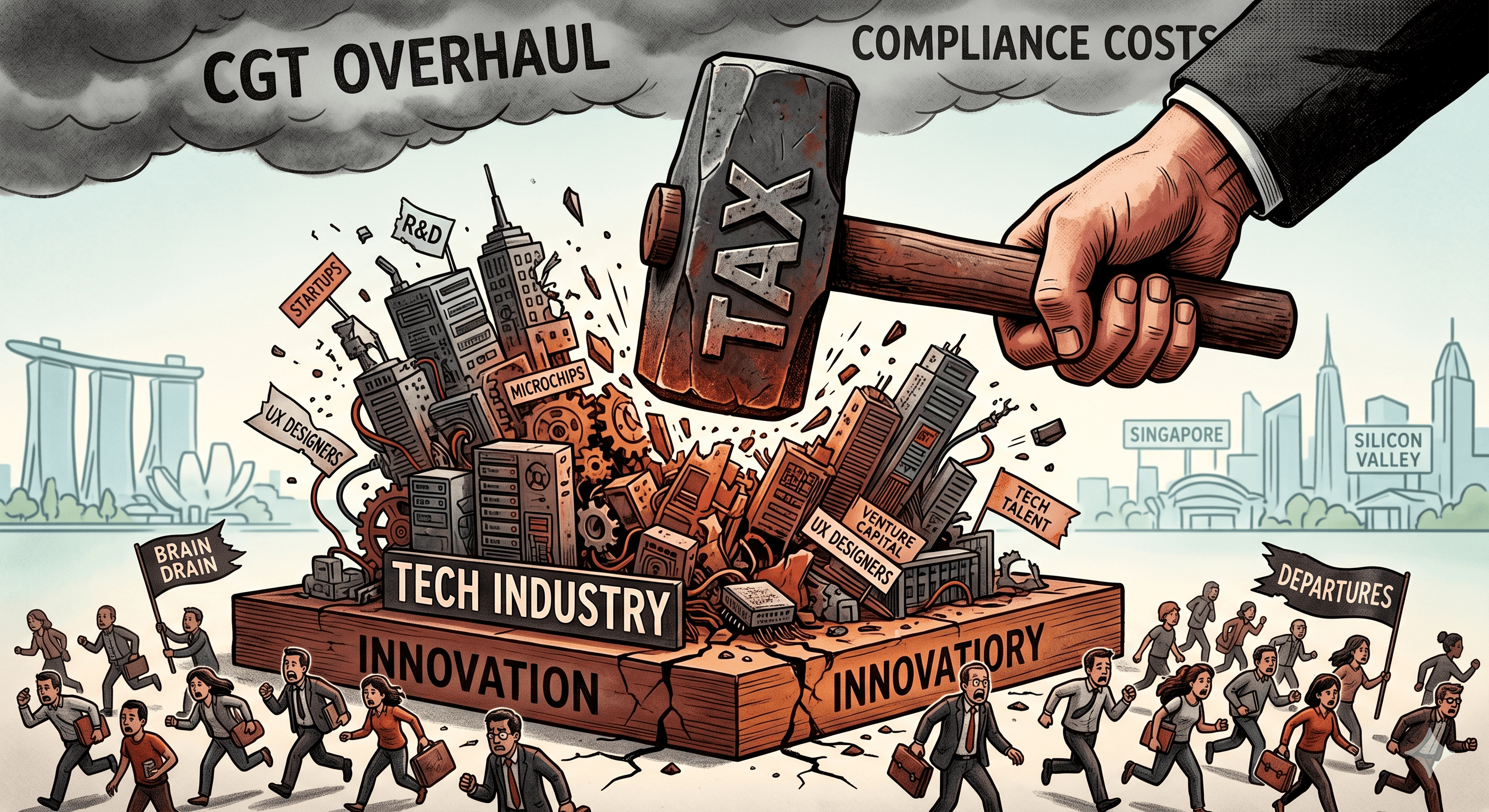
By killing the historic 50% Capital Gains Tax (CGT) discount and replacing it with a complex cost-based indexation and a brutal 30% minimum tax floor on real gains, Canberra has sent a chilling message to the tech sector.
If you take a massive gamble and beat the 80% failure rate, the state will be right there at the finish line to take a significantly larger cut of your reward.
For an industry already starved of venture capital, this isn't just a policy tweak; it’s an existential threat. And for the Australian User Experience (UX) community, the downstream effects will reshape the job market from the top down.
The Illusion of Choice: Australia vs. The World
If you are a founder sitting in Sydney or Melbourne drafting a pitch deck today, you have to look at this budget and ask a simple question: Why build this in Australia?
Tech innovation is completely portable. A line of code doesn't care about geography. When choosing where to incorporate, founders look at ecosystems that reward risk. Let's look at the global landscape:
Singapore: Boasts a 0% capital gains tax rate. It actively courts tech talent with seamless corporate setups, access to massive regional hubs, and zero tax penalties on founder exits.
The United States: Through structures, like Qualified Small Business Stock (QSBS), founders and early investors can often exclude up to 100% of their capital gains from federal tax upon an exit, specifically to incentivise early-stage risk.
Australia (Post-Budget 2026): A minimum 30% effective tax rate on your gains, backed by a complex calculation system that penalises long-term perseverance and asset growth.
As prominent tech voices and investors have noted since the budget dropped, we have essentially penalised founders for the years they spend scaling a company. The inevitable result? A massive brain drain. Ambitious Australian builders won't stop building; they will simply hop on a flight to Singapore or flip their company structure to a US Delaware corporation before they write their first line of code.
The Downstream Casualty: The UX Job Pool
When capital formation is suppressed and startups flee overseas, the local employment market takes the hit. UX designers, researchers, and product strategists are squarely in the firing line. Here is how:
1. The Disappearance of the "Equity Hook"
Startups rarely win talent by matching the massive cash salaries of CBA or Atlassian. They win talent by offering Employee Share Schemes (ESS)—the promise that early designers can ride the equity wave to a life-changing payout. By altering how equity awards are taxed post-exit, this budget severely devalues the "equity hook." If top-tier senior UX designers can't get a tax-discounted upside on their shares, they won’t risk joining a scrappy startup. They will stay safe in corporate tech, suffocating grassroots innovation.
2. Radical Shrinkage of Product Discovery Roles
When local startups struggle to secure investment because private capital is disincentivised, they run on dangerously lean budgets. In a cash-starved startup, UX Research and product discovery are almost always the first casualties. Companies shift into survival mode, focusing strictly on engineering minimum viable products (MVPs). The demand for strategic UX designers evaporates, replaced by a need for cheap, execution-focused UI pixel-pushers who can just get a functional layout out the door.
3. The "Corporate Monopoly" on UX Talent
As early-stage and growth-stage startups either collapse or move their head offices to Singapore, the remaining Australian UX job pool will become incredibly top-heavy. The vast majority of design jobs will be consolidated inside risk-averse enterprise giants—major banks, telecommunications monopolies, and massive federal government consultancies. The vibrant, experimental, fast-paced design culture that breeds world-class product thinkers will be replaced by bureaucratic compliance design.
The Bottom Line
You cannot tax risk out of existence and expect innovation to flourish. By treating capital gains like a simple loophole rather than an incentive machine for builders, the 2026 budget actively discourages anyone from taking a swing at the 4-out-of-5 failure rate.
Australia is signalling that it wants to be a consumer of global technology, not a creator of it. For the UX community, it means fewer local products to build, less equity worth fighting for, and an ecosystem that forces our best design minds to look overseas for true opportunity.
Here are the direct source links covering the 2026/27 Federal Budget's capital gains tax overhaul and the tech sector's reaction:
Official Policy Details & Government Explanations:
Startup & Venture Capital Industry Reaction:
Technical, Financial, & Legal Analyses:
Ernst & Young (EY) Global Tax News — Australia's 2026-27 Federal Budget Update
Financial Services Council (FSC) — Fact Sheet: Impact of CGT Changes on Investors
Chartered Accountants Australia & New Zealand — Proposed Capital Gains Tax Changes Analysis
PwC Australia — Federal Budget Tax Analysis and Insights: Investment
William Buck Australia — Federal Budget Analysis 2026: Capital Gains Tax
National Australia Bank (NAB) — 2026 Federal Budget: What it Means for Individuals
Corrs Chambers Westgarth — Australian Federal Budget 2026-27: Corporate Tax Measures
More Ideas
Thoughts, concepts, and ongoing explorations