The UX Profession is Hollowing Out
Katrina Ryl
Most of the industry is dancing around this conversation. After 25 years designing complex systems, from mining control rooms to enterprise software, I'm going to say it plainly.
Date
Every few days, someone publishes a reassuring think piece about how AI will never replace designers because we bring empathy, creativity, and human judgment to the table. I understand the impulse. But after building interfaces for environments where getting a decision wrong means a haul truck drives into something, I have very little patience for comfortable stories.
So let me tell you what I actually see happening.
The middle is collapsing
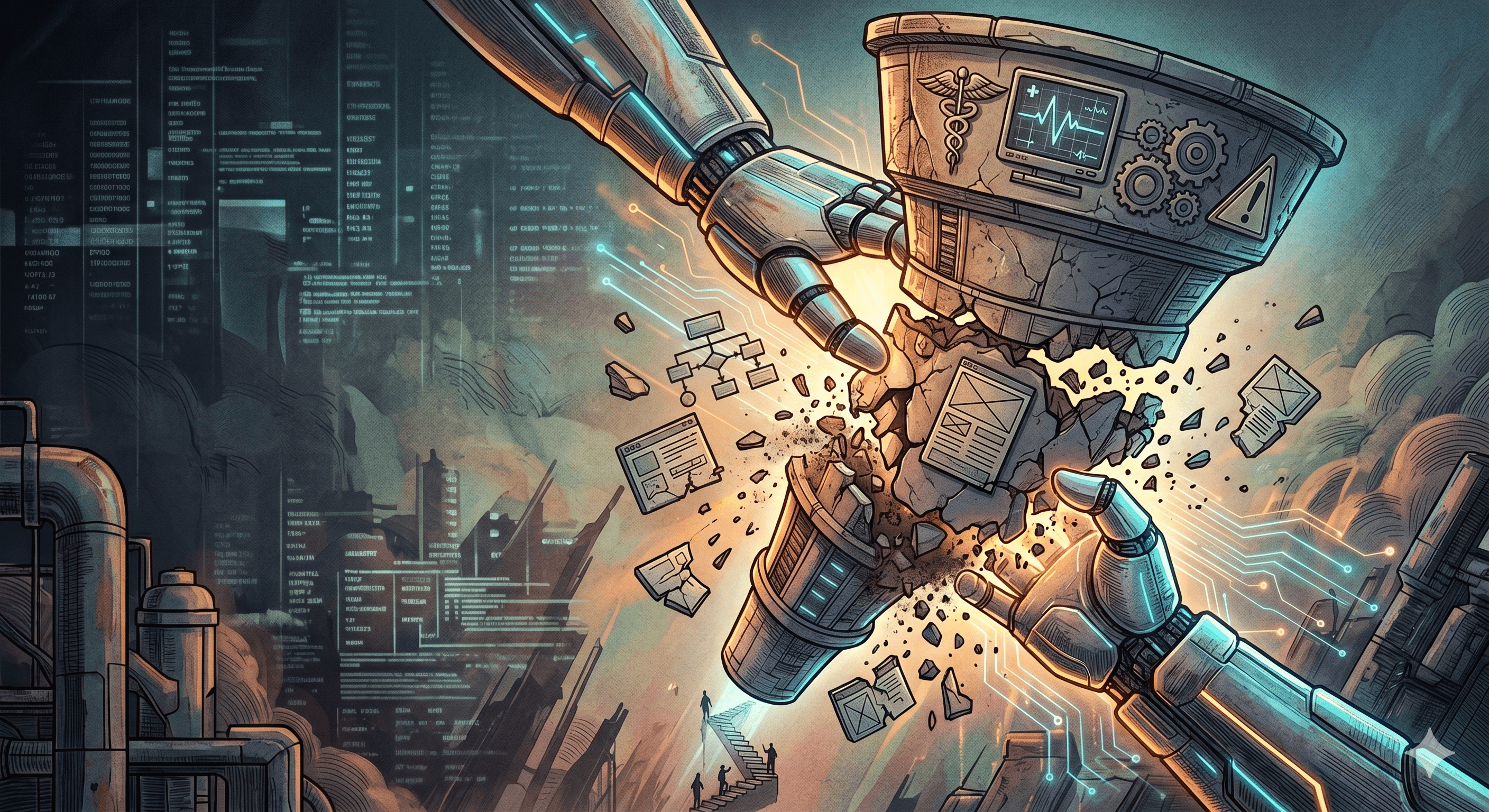
The UX profession has always had a wide middle, the generalists who wireframe, run usability studies, write personas, map journeys, and produce a decent interface for a product they've never encountered before. That middle is being automated faster than most people want to admit.
AI tools can already produce wireframes from a brief. They synthesise usability test transcripts in minutes. They generate journey maps, personas, and copy at a rate that makes a junior designer's output look slow and expensive by comparison. The economic argument for hiring entry-level generalists is weakening in real time.
"The question is no longer whether AI affects UX. It's which parts of UX have defensible value when the commodity work disappears."
This creates a pipeline problem that the industry isn't talking about
Junior roles exist for two reasons: cheap labour and talent development. AI is undercutting both. And if junior roles disappear, the traditional path to senior expertise disappears with them. You can't skip from a design bootcamp to a lead role without somewhere to make mistakes and build judgment. The profession doesn't just contract; it can't reproduce itself.
This isn't hypothetical. It's already showing up in hiring patterns. Entry-level UX positions are becoming rarer. Senior roles are still posting, but with expectations that would have been considered unreasonable five years ago. The gap is widening.
What isn't being automated and why it matters
Here's where I push back on the doom narrative. Automation has reshaped professional fields before, and they didn't disappear. Accounting survived spreadsheets. Architecture survived CAD. What happened in both cases is that the bottom contracted, the middle got compressed, and the top became significantly more valuable.
UX will most likely follow the same pattern. Fewer practitioners, higher bar, and a much stronger premium on domain expertise.
What actually holds its value
Domain expertise in high-stakes regulated environments is genuinely hard to replace. The knowledge required to design an effective alarm management interface for a processing plant, understanding ISA-101 compliance, operator cognitive load during abnormal situations, and fatigue-induced error patterns at shift change, isn't available in general training data. It takes years of fieldwork and real consequences to develop it. AI can generate a control room interface. It cannot be held accountable for an operator misreading a critical alert.
Research design (not synthesis) holds value too. Knowing what question to ask, how to structure a study that produces a reliable signal rather than noise, and when to challenge what stakeholders think they need is a judgment skill, not a template skill.
Facilitation and organisational influence will remain stubbornly human. Getting engineering, safety, regulatory, and product teams aligned on a design decision is a political and social problem. No prompt solves that.
The honest advice for anyone entering UX now Don't enter as a generalist. Pick a hard domain, such as industrial control systems, healthcare infrastructure, financial risk tools, accessibility for complex workflows, and build deep knowledge alongside your design skills from day one. A portfolio of app redesigns and e-commerce flows will have almost no defensible value within three years. |
The commercial adjustment is harder than the skills adjustment
For experienced practitioners, the skills shift is real but manageable. You learn to direct AI output rather than produce the output yourself. You develop prompt architecture and workflow design as core competencies. You stay current with tooling.
The harder adjustment is commercial. Clients will expect the same deliverables faster and cheaper because they assume AI has absorbed most of the labour. If you're pricing on hours, you will feel this immediately. The defence is pricing on outcomes and depth of expertise and having the evidence base to justify it. Published thinking, documented outcomes in complex environments, and a track record in systems where failure has consequences. That evidence is what separates a designer from a prompt engineer with a Figma licence.
Where this leaves the profession
UX as a generic discipline is in structural decline. UX as a deep specialisation applied to genuinely complex problems is in a better position than it has been in years. Precisely because the noise floor is dropping, and the people who have real expertise are becoming easier to identify.
The designers who will struggle are the ones waiting to see how this plays out. The window for strategic repositioning is open now. It won't be indefinitely.
If you've spent years building knowledge in a hard domain, document it, publish it, and make it visible. That is the work that matters right now.
More Ideas
Thoughts, concepts, and ongoing explorations