
Making Entitlements Accessible for Australia's Coal Worker
A digital transformation with people at its centre
CoalLSL needed to modernise how 50,000+ black coal mining employees accessed their long service leave records, a manual, paper-heavy system that was failing shift workers at every turn.
Date
Client
CoalLSL
Skills
Research
Prototyping
Service Design

The Challenge
CoalLSL is the Australian Government body responsible for managing portable long service leave for employees in the black coal mining industry. Despite administering entitlements for tens of thousands of workers, the process for employees to check their own balances, verify their accrued hours, or apply for leave was almost entirely offline, dependent on phone calls during business hours that didn't align with shift rosters, paper forms, and manual processing.
I was brought in as lead service designer to map the current experience, surface the systemic friction, and design a future-state digital service that would work for people in a tough, non-desk environment. This wasn't just a digital project. It was a trust project.
The Problem
Shift workers couldn't access their own records on their own time
Employees may not be able to contact CoalLSL on the phone during normal business hours, and because of confidentiality concerns, requesting access to their records cannot be completed using email.
The core tension was straightforward but significant. Mining workers often work 12-hour shifts, FIFO rosters, and irregular hours. CoalLSL's support lines ran 9am–5pm Monday to Friday. That mismatch alone meant employees couldn't self-serve, and they were entirely dependent on their employer to act as an intermediary.
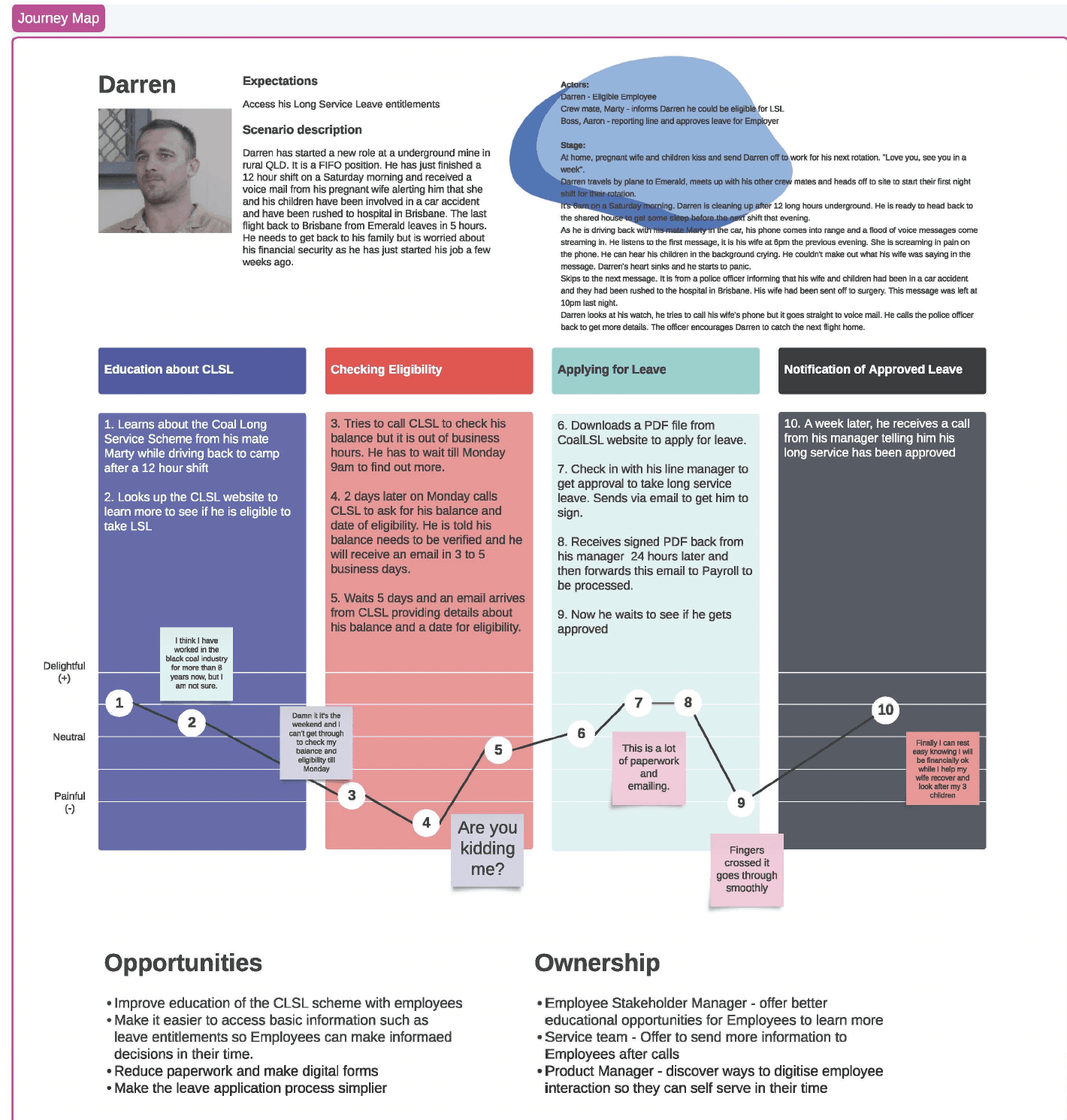
The problems compounded from there. The leave application involved hunting for a PDF on a website, calculating base hours manually, remembering a rarely-used portal login, printing the form, getting a manager's signature, emailing it through payroll, and waiting up to five business days, just to find out if it was approved. A sample user journey map told the whole story of a worker who found out about a family emergency on a Saturday night, couldn't check his eligibility until Monday, and spent the week in uncertainty while his family waited in a hospital far away from the mine site in which he was working.
9–5Only time to call Coal LSL which is misaligned with shift work | 1–5 daysWait time from leave application to eligibility confirmation |
95%Of employees wrote incorrect information on manual forms | 30minAverage time spent hunting for base hours from payroll |
Research
Getting close to people who don't sit at desks
I ran a mixed-method research phase that included stakeholder interviews with both internal Coal LSL staff (Employer Relations and Service Team) and external users, employers and employees across the black coal sector. I combined that with observational research, contextual inquiry, and a thorough review of the organisation's value proposition and strategic priorities.
The key challenge was that many workers are digitally reluctant, geographically remote, time-poor, and operating on shared devices. Research had to be designed around them, not the other way around. I conducted interviews outside standard business hours and used artefacts that were easy to engage with on the fly.
What the research told me
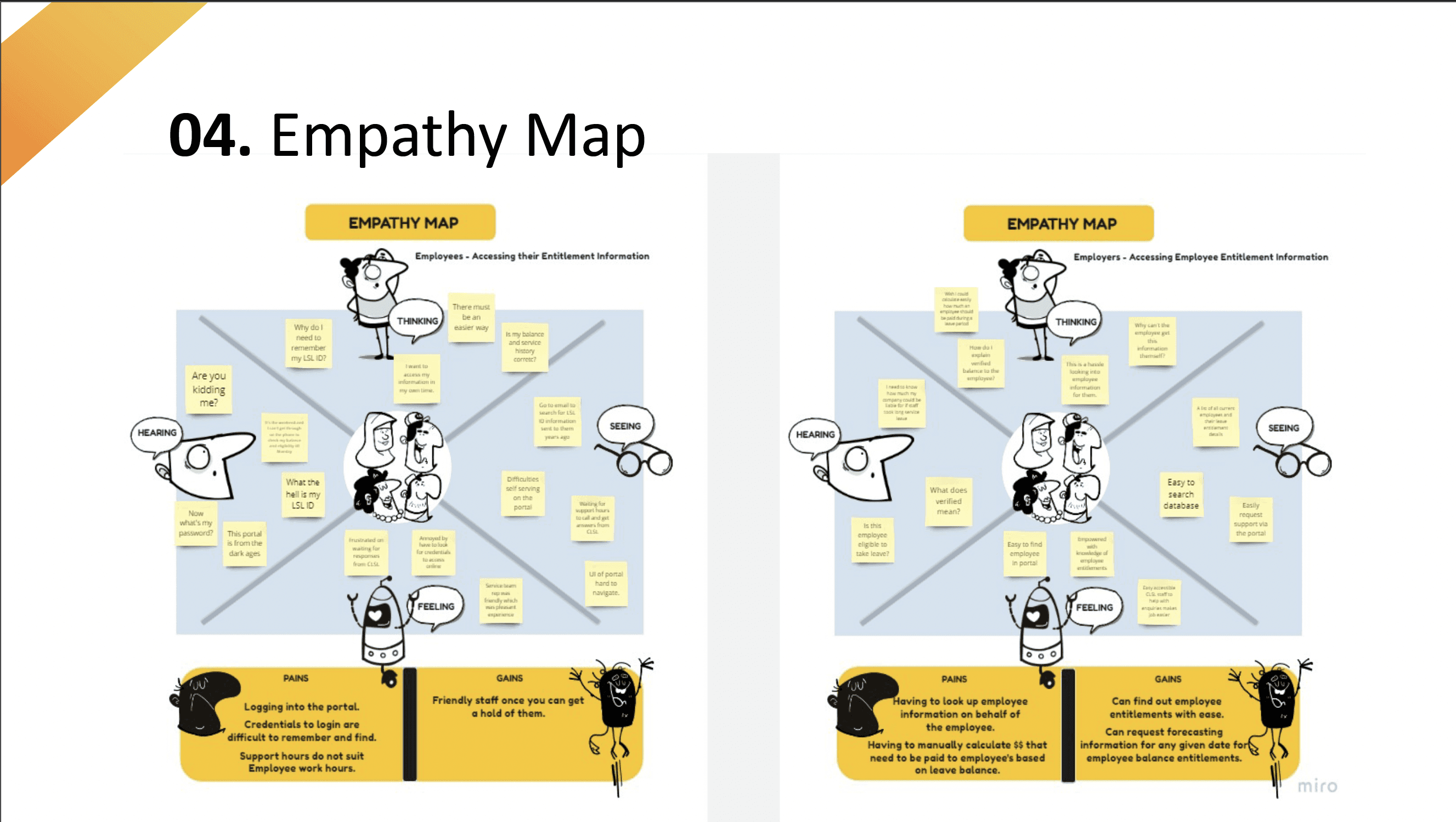
Employees trusted the system in principle, but not in practice; they couldn't verify that their hours were being accurately recorded by their employer
Employers had significantly more digital access to entitlement data than the employees it belonged to, a fundamental equity problem
The LSL ID (a required login credential) was rarely remembered, and password recovery was broken enough to cause abandonment
Older workers approaching retirement had the most at stake financially and the least confidence with digital tools, yet they were the ones most urgently needing access
Mobile phone coverage at many mine sites is patchy, any digital solution needed to work intermittently and clearly
Synthesis
From raw insights to a clear design direction
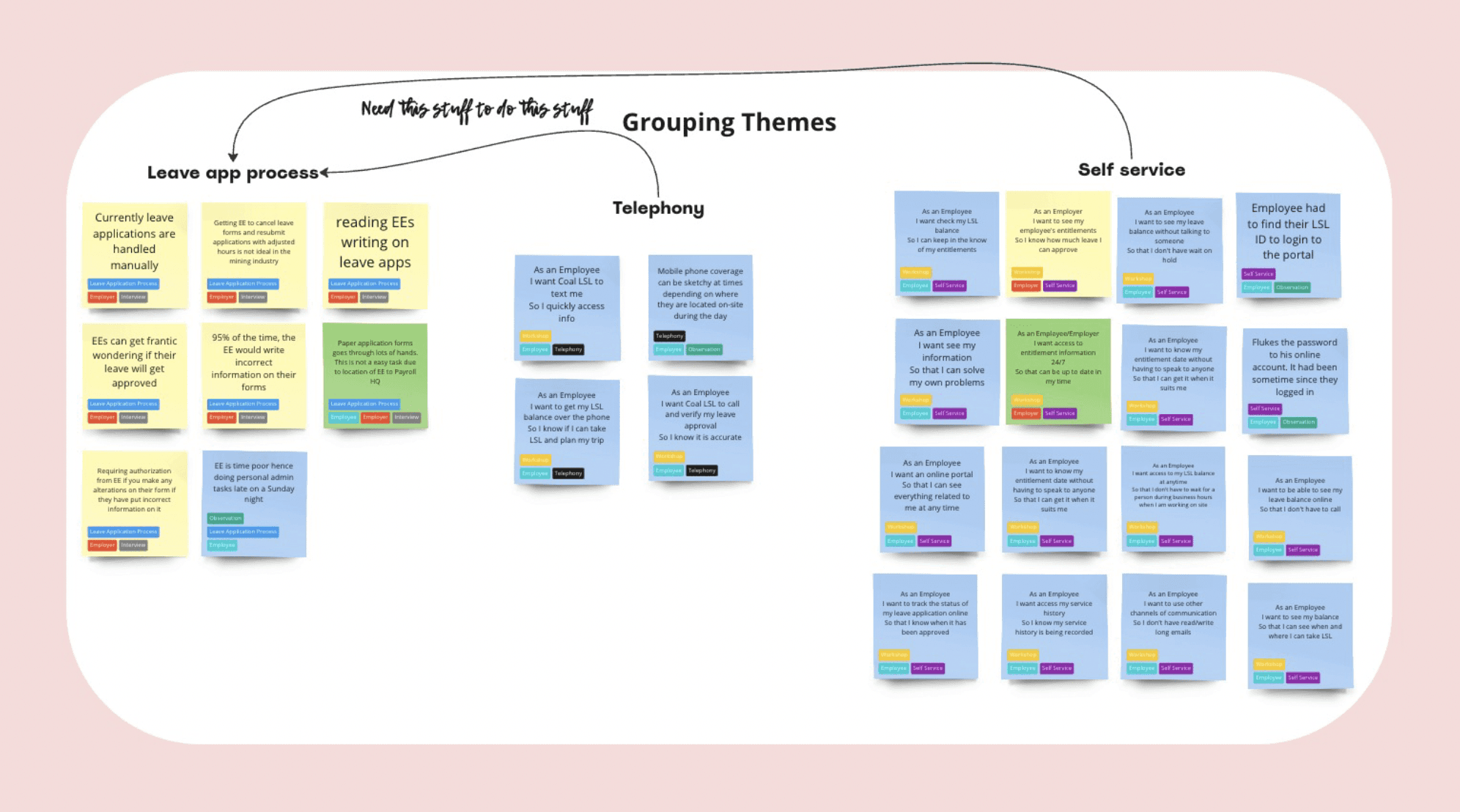
I synthesised the research using affinity mapping, grouping findings into four dominant themes: the leave application process, telephony and support access, self-service needs, and accessibility for non-tech-savvy users. Empathy mapping across both the employee and employer personas made visible the stark contrast in experience — employers could look up employee data at will; employees couldn't see their own.
Two personas anchored the work:
The Employee user
59 years old, approaching retirement, no home computer, low-tech confidence. He needed to cash out accrued hours and understand his financial position for retirement, but couldn't navigate the portal, couldn't remember his credentials, and lived remotely with limited phone support access. Stuart represented a significant user segment who needed the system to meet them, not the other way around.
The Employer user
46 years old, SAP-literate, process-driven, and fielding daily questions from employees about their entitlements. She was already doing the work the system should have been doing. Her frustration wasn't with the technology; it was the gaps in data quality and the time wasted on problems that shouldn't require a phone call.
Design Process
From the current state blueprint to the future-state service
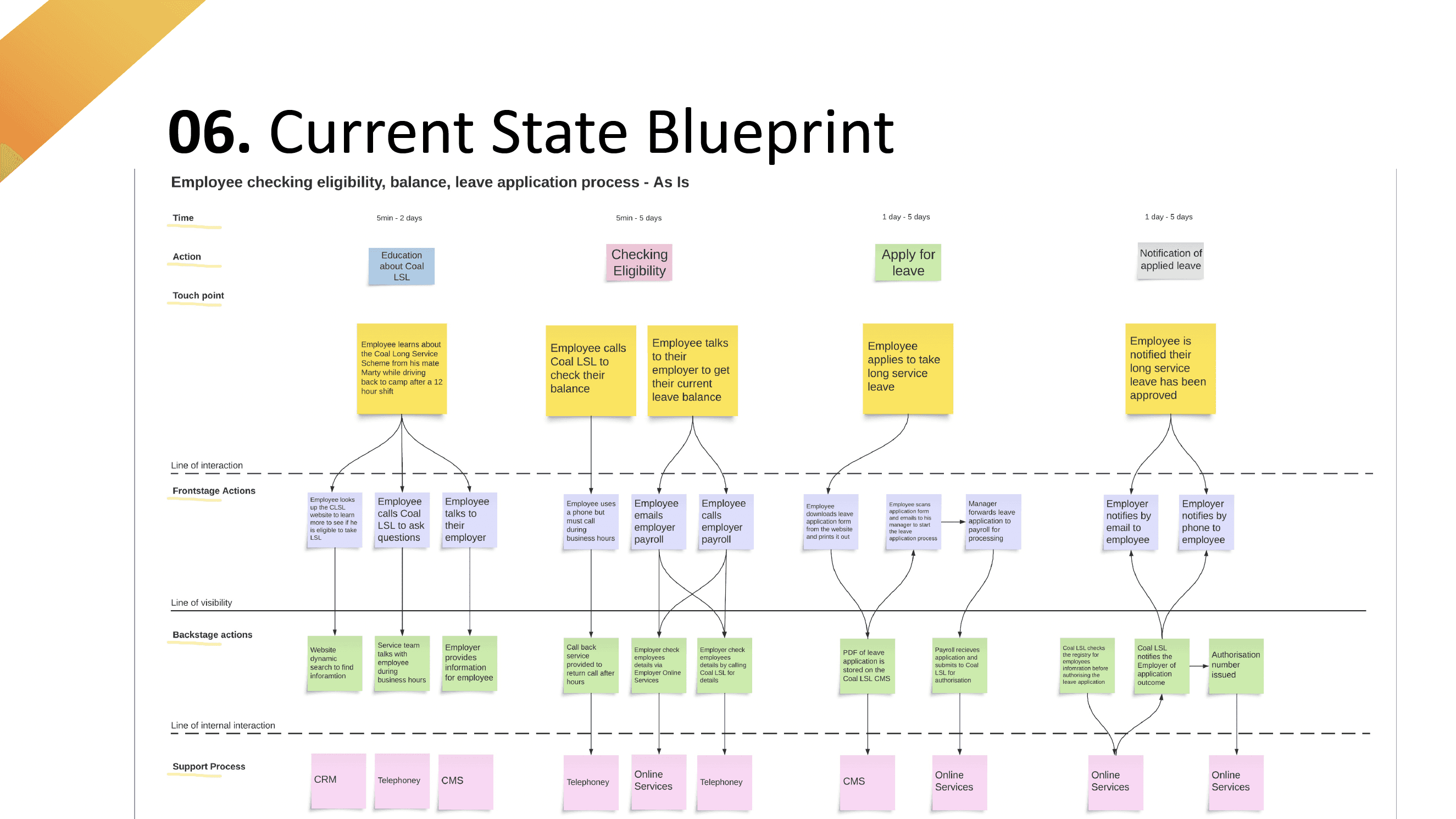
01Current State Blueprint Mapped the end-to-end service across frontstage and backstage actions, touchpoints, and support systems | 02Jobs to be Done Reframed user needs as outcome-based statements to drive ideation without prescribing solutions | 03How Might We Three HMW scenarios across employer access, employee tracking, and retirement-specific leave education |
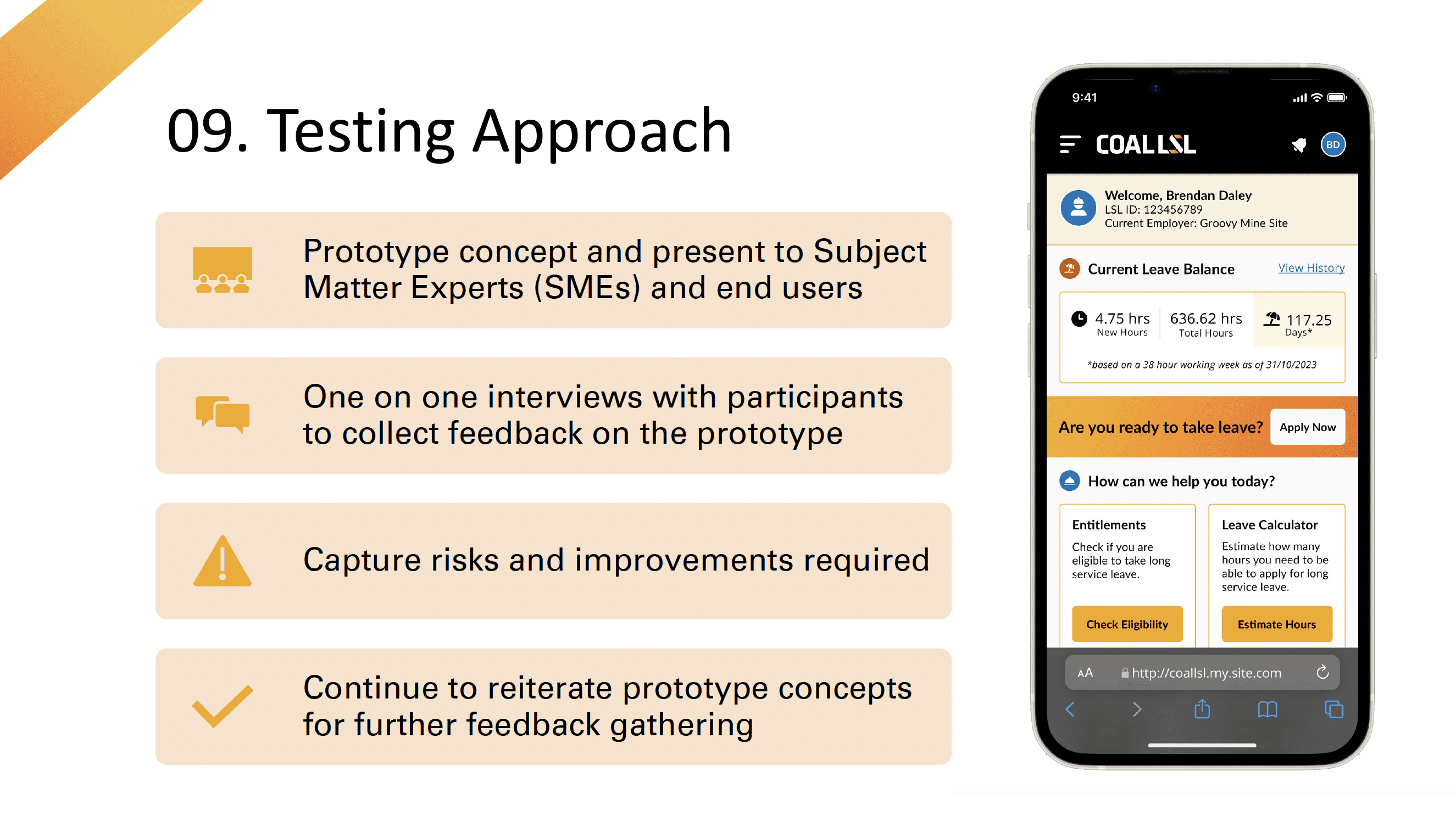
04Crazy 8s + Concept Poster Rapid ideation workshops with SMEs; surfaced a digital tracking concept for employee leave applications | 05Rapid Prototype Storyboarded and wireframed a 6-step digital leave application flow; built a mobile-first prototype for testing | 06Usability Testing One-on-one testing sessions with SMEs and end users; iterated on feedback before future-state blueprinting |
The current state blueprint was confronting. The employee's leave journey stretched across four phases: education, eligibility checking, applying, and notification, with timelines of up to ten days and dependencies on manual backstage actions at almost every step. Every node that required a phone call was a point of failure for shift workers.
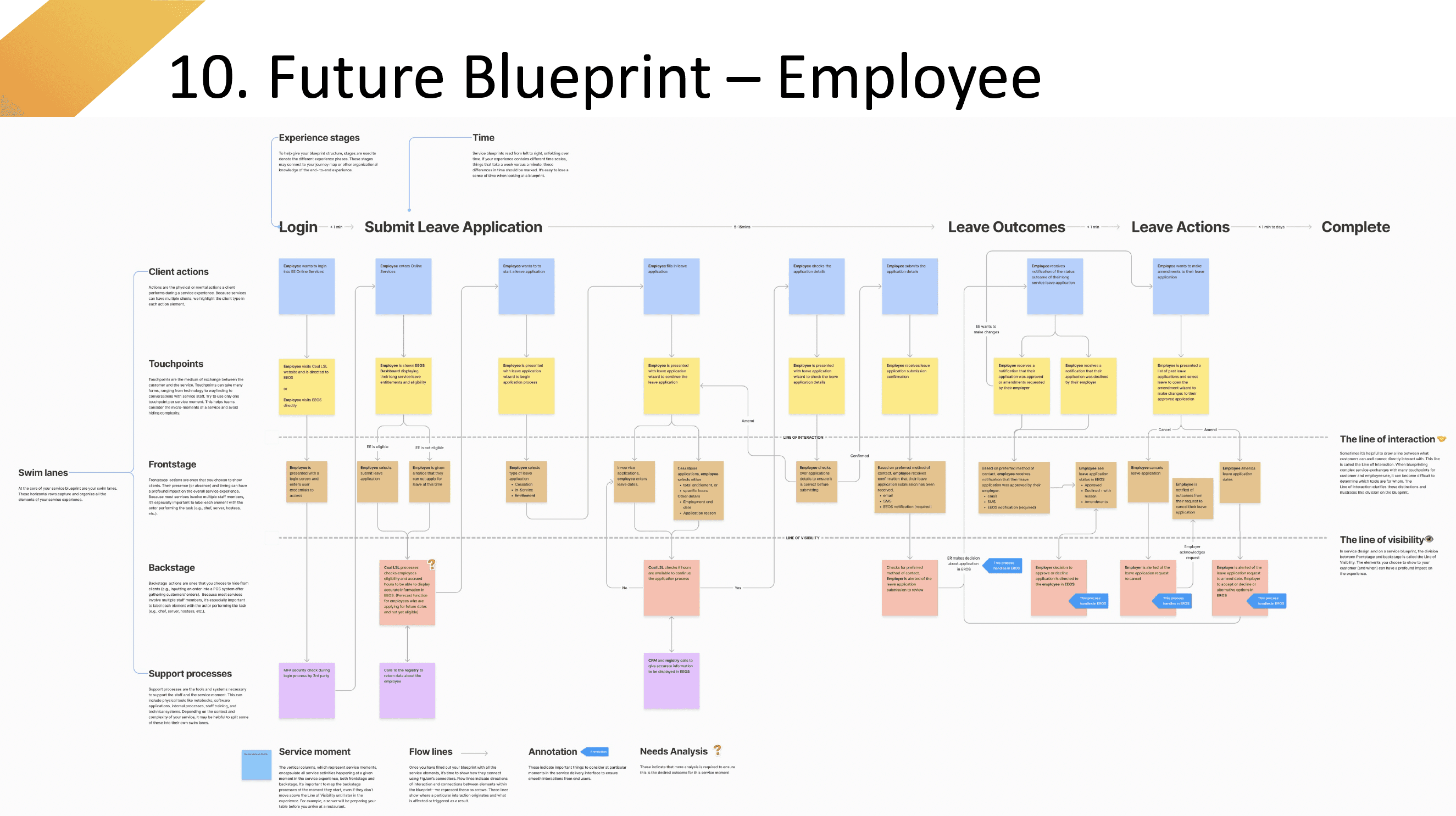
The prototype consolidated that entire journey into a mobile-accessible self-service flow. Employees could log in, see their current balance with an eligibility summary, initiate an application, select leave type and dates, and submit, with the system routing automatically to their employer portal for review and to CoalLSL for authorisation.
Outcome
What would the future-state service change?
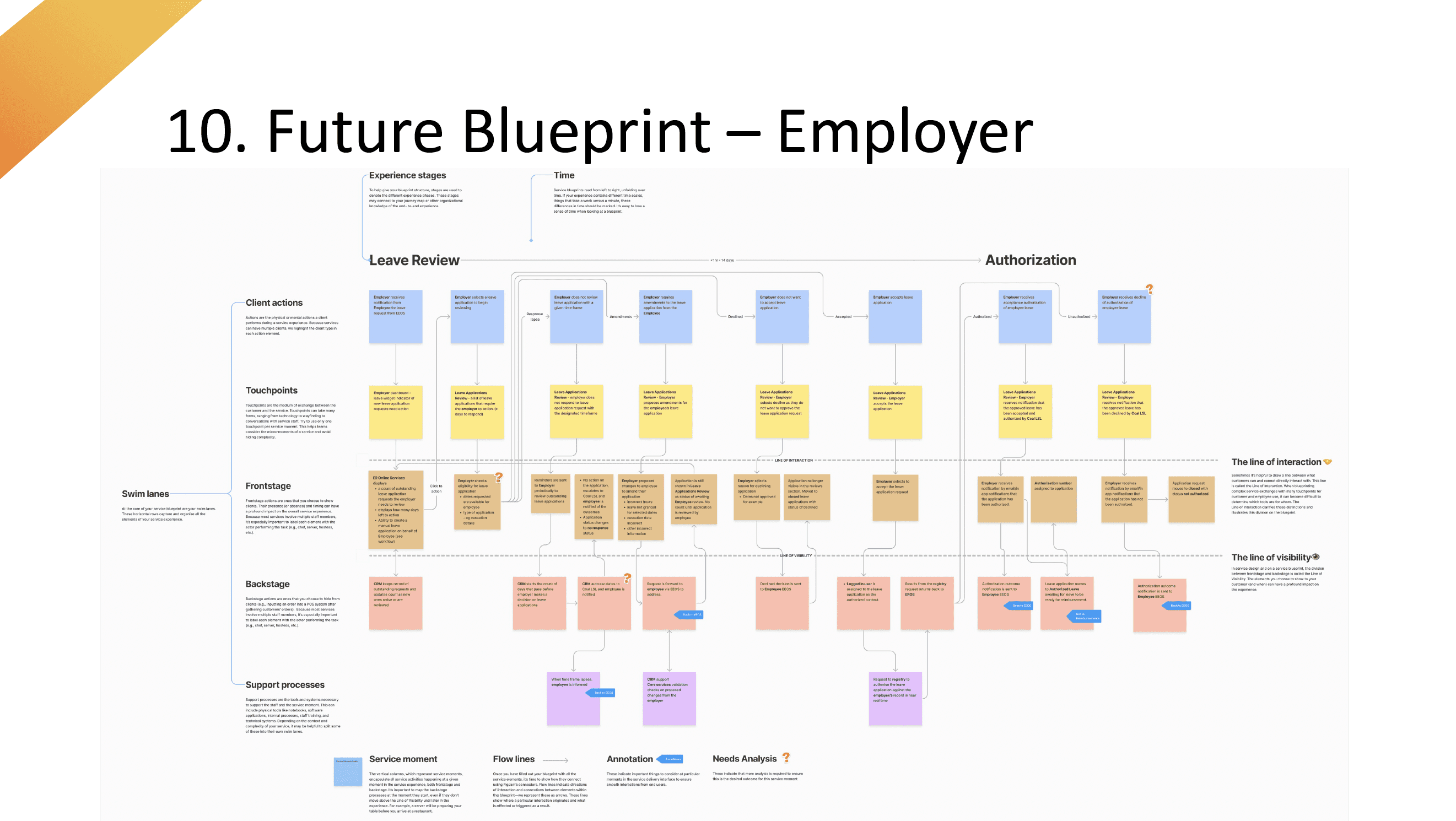
The future-state blueprints, one for the employee journey, one for the employer, showed what the service could become if the backstage systems (CRM, registry, online services) were properly integrated. The design removed the telephone dependency from routine transactions entirely, replacing it with automated notifications, digital tracking, and self-service eligibility checks.
24/7 entitlement access
No paper leave applications
Employer portal integration
Reduced phone call volume
Faster application turnaround
Fewer declined applications
Reduced employer overhead
Improved data accuracy
For CoalLSL as a government entity, the benefits were strategic as well as operational. The design addressed three of their key risk areas: the inability to scale service delivery, regulatory gaps caused by data quality issues, and reputational risk from failing to modernise. It supported the KPMG recommendations already on the table, particularly around safeguarding the scheme from fraud through better data integration, and increasing visibility of entitlements and payments.
"This means I can access my entitlements when it suits me and my family in my time."
More Projects
Recent projects in web design and digital products