UX, Service Design, CX, Marketing: Same Job, Different Altitude
Katrina Ryl
The market currently demands two contradictory things. Job postings hunt for "unicorns" who can do everything, while hiring panels reward specialists who have stayed in a single lane for a decade. If you are a designer weighing a pivot between UX, Service Design, CX, or Product Marketing, this contradiction is actually good news. These disciplines share far more DNA than their job titles admit.
Date
The altitude model
The cleanest way to view these disciplines is not as separate professions, but as the same practice operating at different altitudes of perspective.
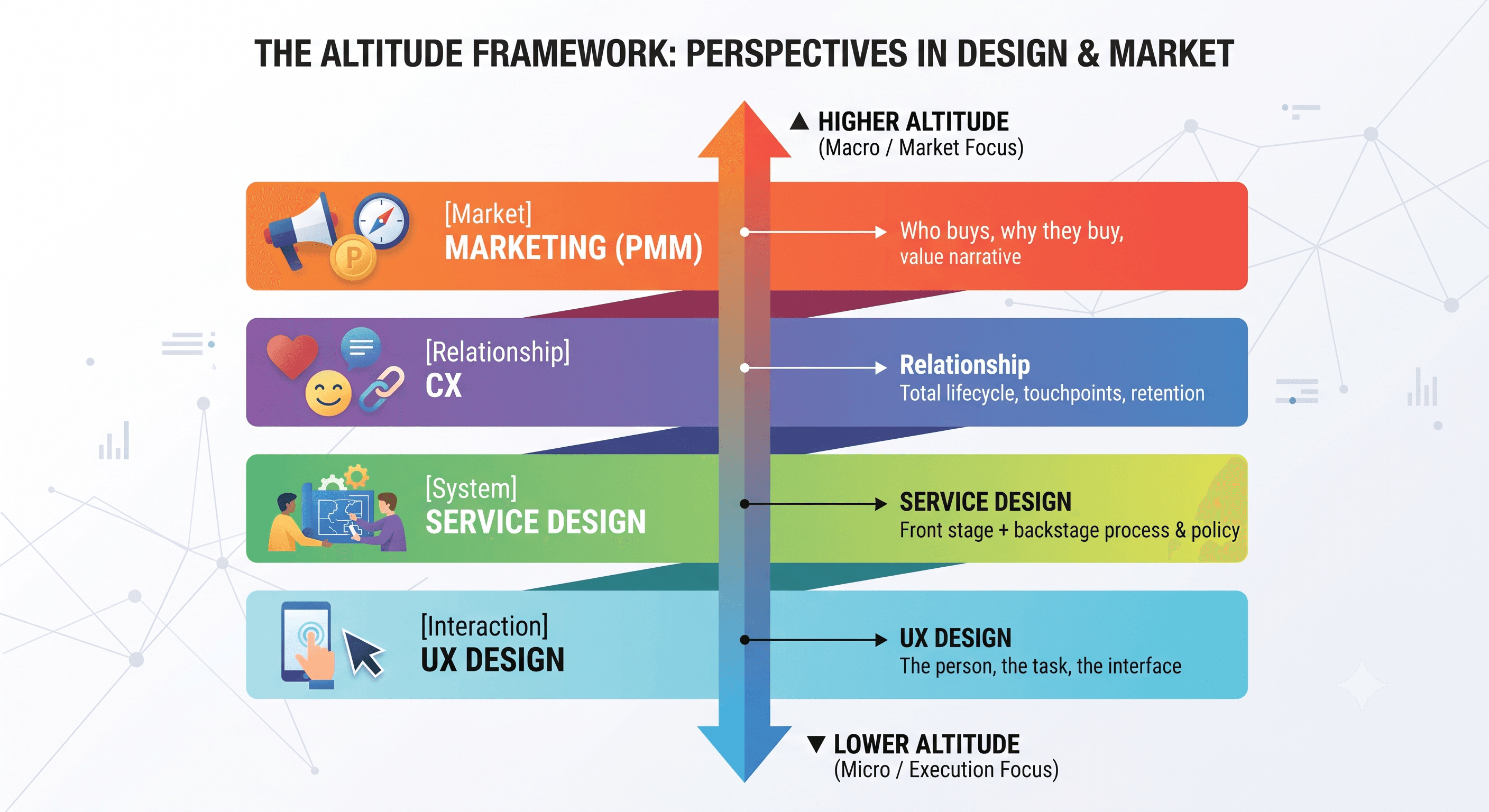
UX Design (Interaction Altitude): Focuses on a person, a task, and an interface.
Service Design (System Altitude): Focuses on the customer-facing "front stage" plus the backstage infrastructure—people, policies, and processes—that makes it possible.
CX (Relationship Altitude): Focuses on the sum of every touchpoint over a customer’s lifetime, directly tied to commercial outcomes.
Product Marketing (Market Altitude): Focuses on who the customer is before they buy, why they should care, and how value is articulated in their language rather than the company's.
The zoom effect
The underlying skill across all four tiers remains identical: understanding human behaviour and designing around evidence rather than opinion.
Zoom in on a service blueprint, and you find interaction problems.
Zoom out from a usability issue far enough, and you find a broken process or a policy failure.
Zoom out further still, and you find a positioning problem—customers arriving with expectations the product was never built to meet.
A crucial caveat: The only credible bridge from design to marketing is Product Marketing (PMM)—which centres on customer understanding, positioning, and narrative. Brand and performance marketing draw on entirely different crafts; claiming those skills transfer automatically will read as naive in an interview.
What genuinely transfers
Four core capabilities carry across every altitude with virtually no translation required:
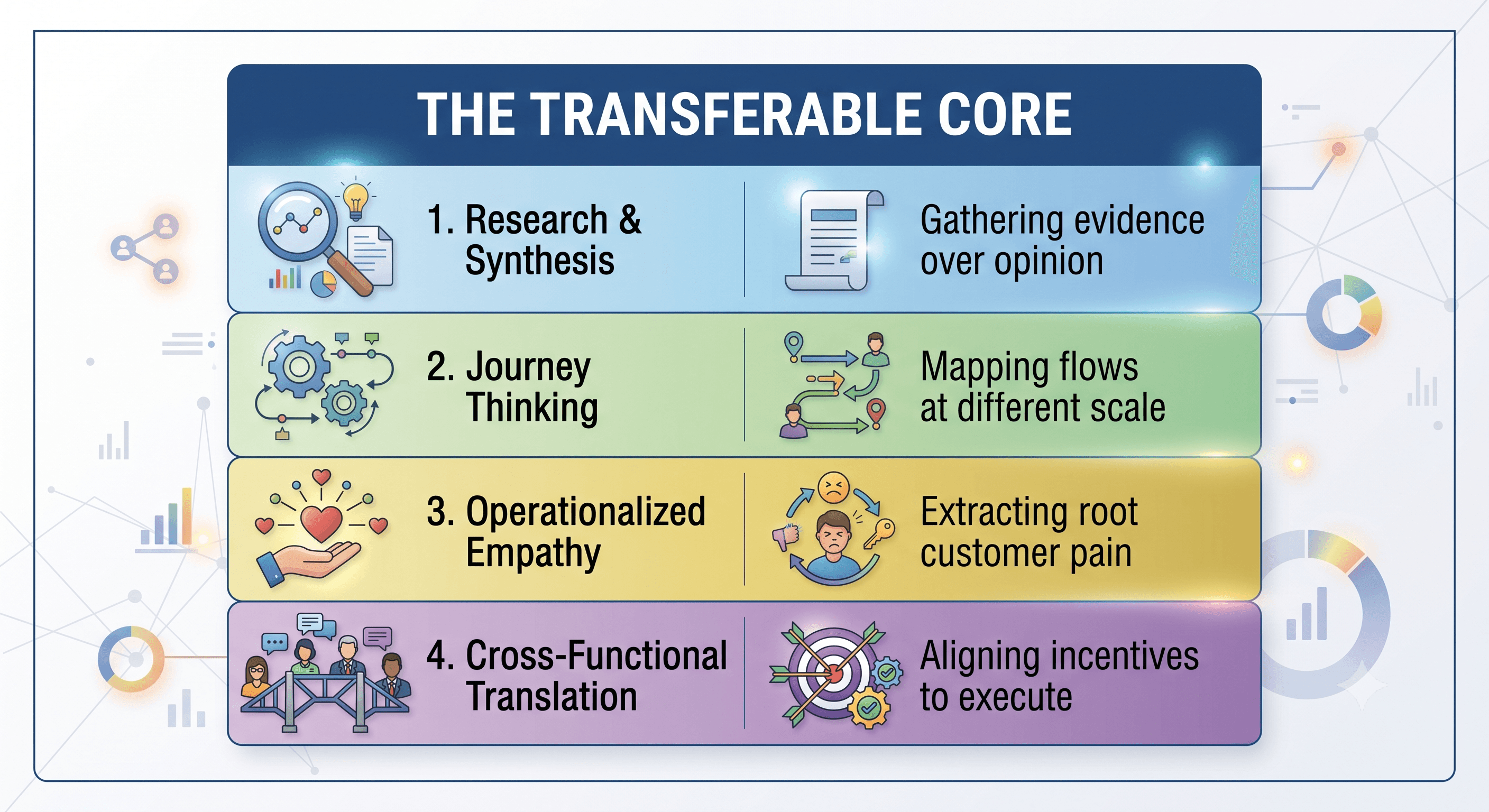
Research and Synthesis: Whether you are running usability tests, conducting contextual inquiries in a control room, mining NPS verbatims, or leading win-loss interviews, the core skill is identical: gathering messy human evidence and turning it into decisions. Designers are often superior qualitative researchers compared to traditional marketers—this is your most underrated asset.
Journey Thinking: A UX flow, a service blueprint, a CX lifecycle map, and a marketing funnel are the same artifact at different zoom levels. If you can map one, you can map the others. You are simply changing the scale of a "step" and the active actors. A funnel is just a journey map with revenue attached.
Operationalised Empathy: This is the practical ability to sit with a frustrated user, a frontline worker, or a churning customer and diagnose the systemic issue beneath what they are saying. Marketing calls this "Voice of Customer" (VoC) and pays a premium for it.
Facilitation and Translation: Enterprise work lives or dies by your ability to get engineering, operations, sales, legal, and leadership into a room and emerge with a shared decision. A product launch is just a service design project with a hard deadline everyone actually respects.
What does not transfer automatically
Honesty matters; pretending the transition is seamless is how pivots fail. You must actively bridge three gaps:
1. The language & metrics shift
While your core craft remains the same, the way your work is measured and defended changes entirely based on your altitude:
Discipline | Core artifacts & concepts | Primary metrics |
|---|---|---|
UX Design | Wireframes, Prototypes, Task Flows | Task Success Rate, SUS, Error Rates |
Service Design | Service Blueprints, Ecosystem Maps | Failure Demand, Operational Cost |
CX | Lifecycle Maps, VoC Programs | NPS, CSAT, Retention, LTV |
Marketing (PMM) | Positioning Frameworks, Funnels | Pipeline, Conversion, Win Rates, Revenue |
2. Stakeholder gravity
UX answers primarily to Product.
Service Design answers to Operations.
CX answers to Commercial Leadership.
Product Marketing sits precariously between Product and Sales, spending much of its time arbitrating between the two.
Learning to read and balance these varying departmental incentives is domain fluency you must build on the job.
3. Delivery cadence
Product teams ship in sprints. Service transformations move in quarters. CX programs move in financial years. Marketing runs on launch and campaign cycles tied to the sales calendar. If you do not adjust your expectations of pace, the speed shift will feel like organisational failure when it is simply the natural terrain.
When to audit your skills
The worst time to map your transferable skills is when you're already out of a role and reverse-engineering a narrative under pressure. The right triggers are earlier:
Your role is compressing. When one title starts absorbing the work of three, the market is telling you it values altitude range over lane purity.
You've plateaued. If the problems stopped surprising you, the next altitude will re-supply the difficulty.
The market is restructuring around you. AI is currently redrawing the boundaries of design roles. The people who fare best in restructures are the ones who can describe their skills independently of their job title.
How to do the audit
Skip the skills-inventory spreadsheet. Do this instead: take your last three significant projects and describe each one four times — at interaction altitude, system altitude, relationship altitude and market altitude. That last version is the hardest for most designers: what did this project change about who buys, why they buy, or what the company can credibly claim now? If you can honestly tell all four versions, you already have the range; what's missing is the vocabulary of the discipline you're moving toward. Learn its metrics, artefacts, and stakeholder map, and lead with them in your positioning.
A note for the people hiring
If you're a hiring manager reading a CV that spans UX, service design, CX or marketing, the question isn't "why couldn't this person pick a lane?" It's "can this person operate at more than one altitude?" — because your hardest problems don't respect discipline boundaries either. A usability defect that traces back to a policy failure that shows up in your churn numbers and undermines your positioning needs someone who can move up and down the stack. Range isn't a lack of focus. It's what focus looks like after enough years of solving real problems.
Titles describe org charts. Skills describe capability. Audit the second, and the first stops limiting you.
More Ideas
Thoughts, concepts, and ongoing explorations